

You’re not crashing randomly.
What gets called inconsistency is often a capacity pattern.
Normal Zebra Method™ helps neurodivergent adults recognise the pattern earlier, understand what’s happening underneath, and respond before the full drop.
The drop is rarely the beginning of the problem.
It’s the point where the pattern becomes visible.
What feels sudden usually isn’t.
Things feel good.
More capacity gets used.
Margin starts to shrink.
Something small tips it.
Then the drop becomes visible.
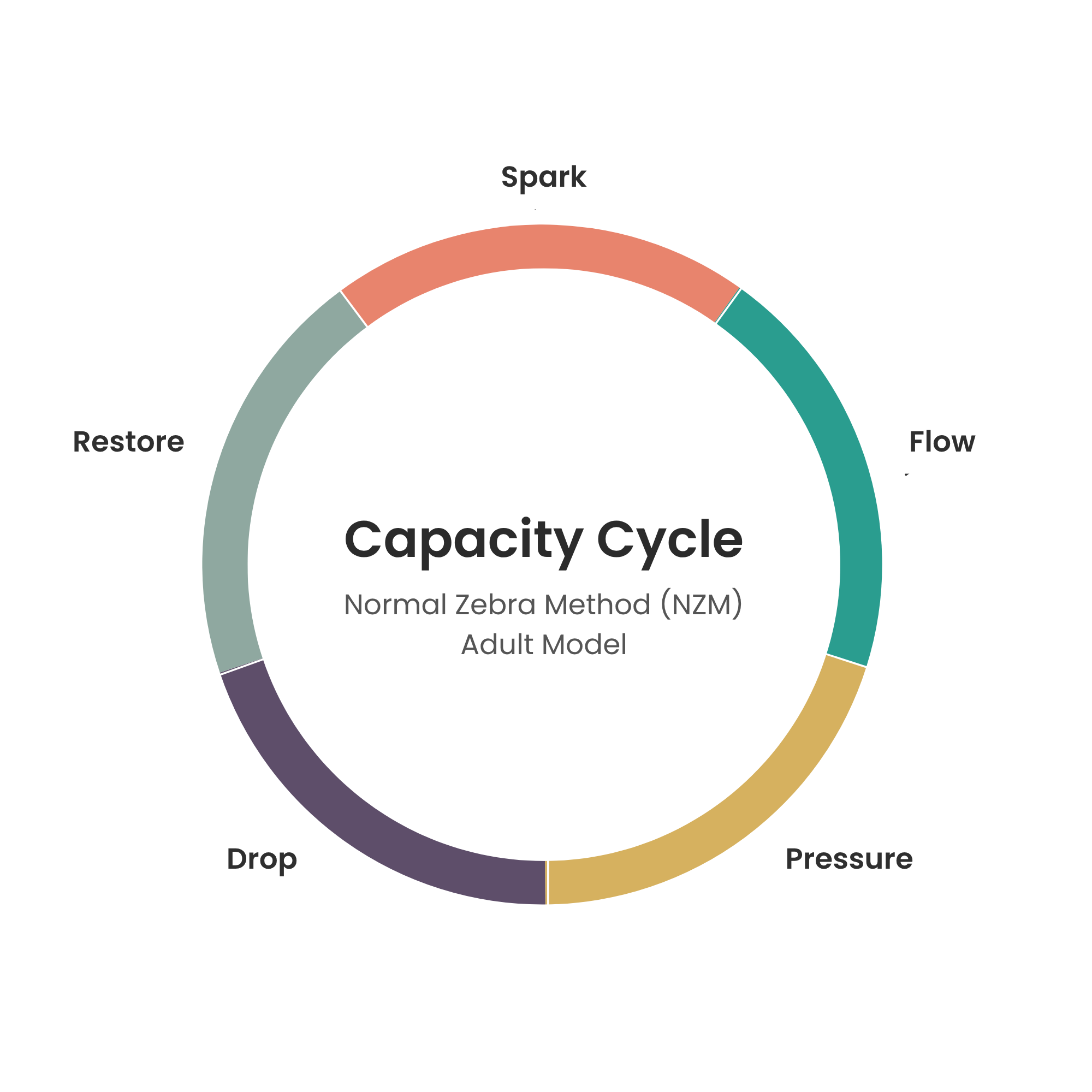
NZM gives you language for the full cycle, not just the drop.
Where do you recognise yourself?
You do not need to relate to every stage.
Start with the one that feels most familiar right now.
Spark
Things feel easier.
Your energy is up.
Your mind is moving quickly.
This is often where it starts.
Flow
You’re productive.
Focused.
Capable.
But you’re using more than it looks like.
Pressure
Things feel tighter.
Decisions feel heavier.
Your tolerance is shrinking.
Something is building.
Drop
You hit a wall.
Everything feels harder.
Your system is overloaded.
This is not failure.
Restore
You’re pulling back.
Slowing down.
Trying to get back to baseline.
This is part of the cycle.
You don’t need to fix everything
Start by responding to the stage you’re in.
Notice
First, notice where you are.
Not where you think you should be.
Not where you want to be.
Where you are right now.
Respond
Then respond to the stage you’re in.
Different phases need different expectations.
Pushing through is not always the answer.
More isn’t always better.
Support
Then support your system properly.
Reduce load.
Create space.
Work with your capacity, not against it.