
Why ADHD Burnout Keeps Repeating
Many ADHD and neurodivergent adults describe the same confusing experience.
For a while, everything is manageable.
Your brain is sharp.
You’re productive.
You’re clearing tasks that have been sitting for months.
You feel like yourself again.
And then, seemingly out of nowhere, something small tips the system.
A conversation.
A deadline.
One more demand.
Suddenly you’re overwhelmed.
Your brain feels foggy.
Your tolerance narrows.
You either shut down, snap, or feel completely depleted.
So you rest.
Eventually you recover.
But then — a few weeks or months later — the same pattern happens again.
If you’ve experienced this cycle, you’re not alone.
Many ADHD adults recognise the pattern immediately.
The question is:
Why does it keep repeating?
The Pattern Many ADHD Adults Notice
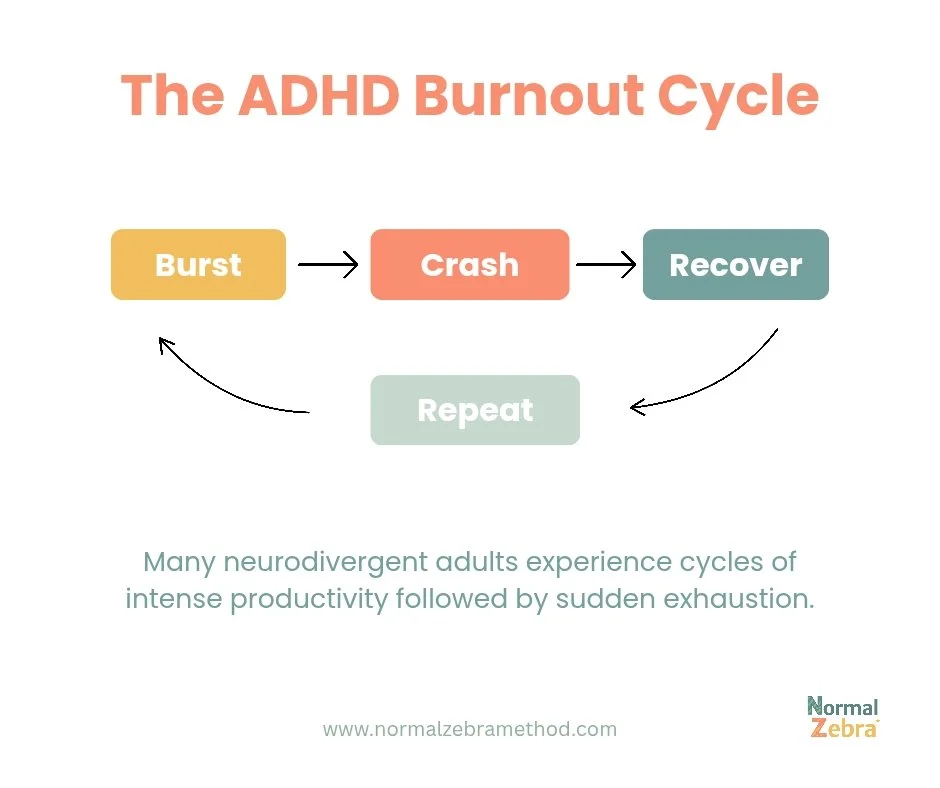
Most people describe the cycle something like this:
Burst
→ Crash
→ Recover
→ Repeat
During the burst phase, your thinking speeds up.
You see connections quickly.
You can hold multiple threads in your head at once.
Tasks that felt impossible suddenly become easy.
You catch up on admin.
You organise things.
You solve problems efficiently.
Because you feel capable, you keep going.
Nothing feels wrong.
Then eventually something small pushes the system past its limit.
And the crash arrives.
Why Traditional Burnout Advice Doesn’t Always Work
Most burnout advice focuses on:
rest
stress reduction
self-care
better boundaries
These things can absolutely help.
But they assume the problem is exhaustion alone.
For many neurodivergent adults, the deeper issue is how capacity is allocated across systems.
When one system ramps up, something else has to compress.
Capacity is finite.
The Capability Paradox
One of the most confusing parts of ADHD burnout is this:
Many people experiencing it are highly capable.
They can produce incredible work in short bursts.
But capability and sustainability are not the same thing.
You can have the cognitive ability to do something
without the system capacity to sustain it long term.
This is what the Normal Zebra Method calls:
Capability ≠ Sustainability
High capability allows powerful bursts.
But bursts often redistribute capacity across different systems:
cognitive processing
emotional buffering
sensory tolerance
executive switching
If one system runs intensely for too long, the others compress.
Eventually the system destabilises.
The Hidden Burnout Cycle
Many neurodivergent adults are actually running a repeating capacity cycle.
It looks something like this:
Burst → Crash → Recover → Repeat
What makes the cycle confusing is that it doesn’t feel predictable while you’re inside it.
During the burst phase you feel capable and productive.
During the crash phase you feel depleted.
During recovery you feel better.
But there is a subtle stage many people miss.
Recovery itself has layers.
Recovery Isn’t One State
After a crash, recovery often moves through stages:
Functional
You can answer messages again.
You can work.
You’re no longer completely overwhelmed.
Comfortable
Your emotional buffer has mostly returned.
You’re not snapping at people.
Things feel manageable again.
Restored
Your system has margin.
Your nervous system isn’t compensating.
Demands don’t spike your stress levels easily.
Many people restart activity during the functional stage.
Because functional feels responsible.
It feels like:
“Okay, I’m back. Let’s get on with things.”
But functional isn’t fully restored.
And this is where burnout cycles often shorten over time.
The Relaunch Trap
The moment that often shortens the cycle isn’t the crash.
It’s the relaunch.
When a system restarts activity before full restoration, the next cycle begins slightly depleted.
You may not feel that missing capacity clearly.
It just feels like life.
But over time the baseline can drift downward.
The Normal Zebra Method calls this pattern:
The Relaunch Trap
Each early relaunch locks in a slightly lower starting point.
Which makes the next cycle less stable.
Why This Pattern Feels So Convincing
The pattern is easy to miss because capability can mask the deficit.
When baseline capacity drops, many people simply increase effort.
They:
push harder
sleep less
tighten routines
reduce downtime
Effort can compensate for a structural deficit for quite a while.
Which is why the next crash often feels sudden.
But the collapse itself wasn’t sudden.
It was cumulative.
The Strength-Biased Brain
One more important point.
This pattern doesn’t mean your brain is broken.
In fact, the opposite is often true.
Many neurodivergent brains are strength-biased.
A brain that struggles in one area will often shine intensely in another.
During burst phases, cognitive processing can become extremely efficient.
This allows:
rapid pattern recognition
intense focus
high productivity
These strengths are real.
But without pacing and calibrated relaunch timing, they can become expensive.
The First Step Toward Breaking the Cycle
If burnout feels random, the only strategies available are:
try harder
rest longer
hope it doesn’t happen again
But if the cycle has structure, the strategy changes.
Instead of asking:
“Why do I keep burning out?”
You start asking:
When did I relaunch?
And:
How long did the burst phase run before something forced a shift?
You don’t need exact numbers.
Just honest observation.
Awareness alone often changes behaviour.
A Final Thought
If you recognise this pattern, you are not inconsistent.
You are running a high-intensity system without structural pacing.
There’s a difference.
Inconsistency implies character.
Miscalibration implies mechanics.
Mechanics can be adjusted.
Understanding the pattern is the first step.
The Normal Zebra Method is a framework designed to explain these patterns in neurodivergent systems.
It explores why highly capable minds can produce extraordinary bursts of output — yet struggle to sustain that potential over time.
If this cycle feels familiar, you can explore the full model here.
